Our Model: Authentic Fair Trade
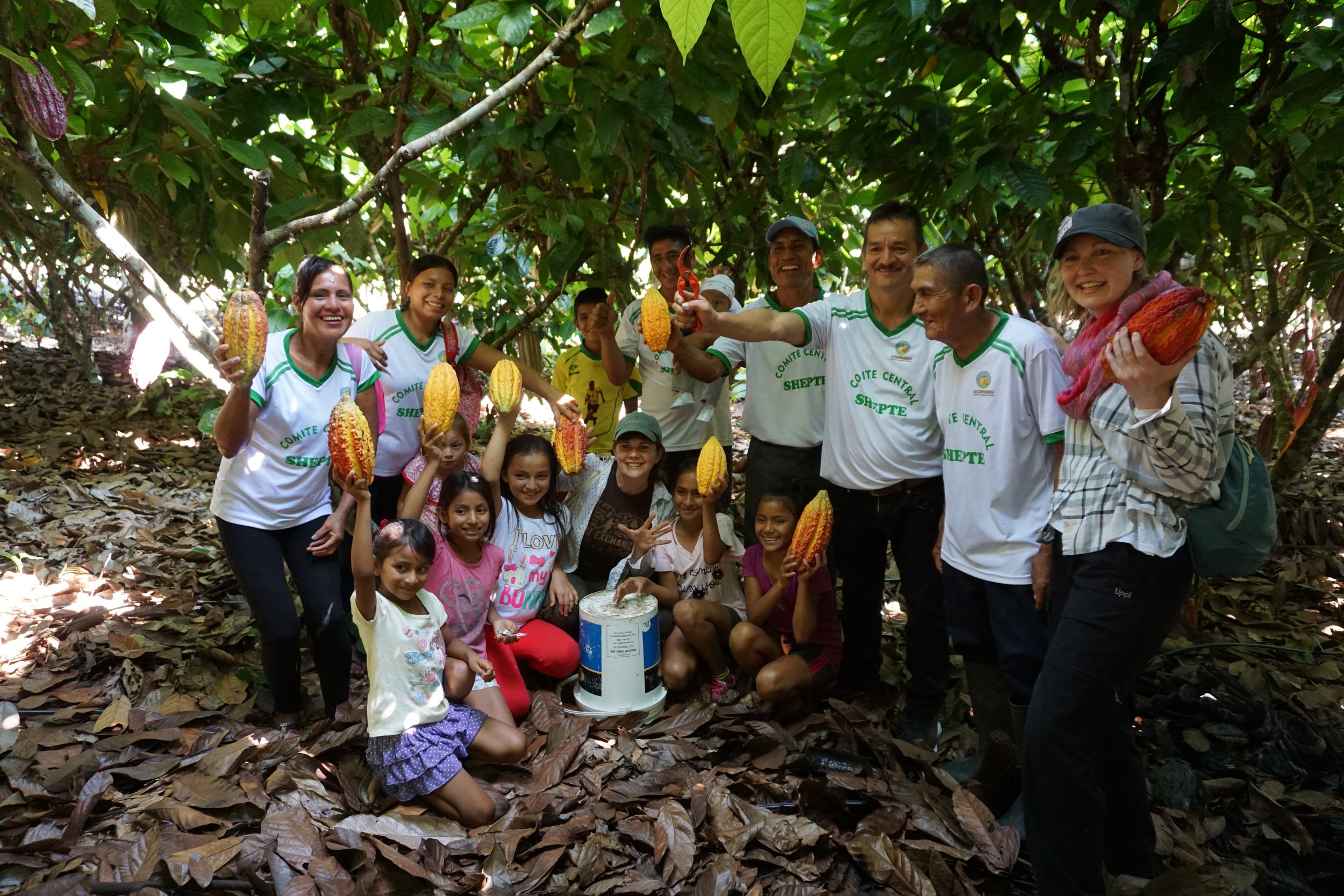
Peruvian ACOPAGRO co-op members of the Shepte committee (including Lilet Sinarahua Satalaya and Juan Calba Merina) and their families showing us a successful harvest (with Laura Bechard from Equal Exchange and Kelly Storie from La Siembra).
In 1986, Equal Exchange was founded to challenge the existing trade model, which favors large plantations, agri-business, and multi-national corporations; support small farmers; and connect consumers and producers through information, education, and the exchange of products in the marketplace. With our founding, we joined a growing movement of small farmers, alternative traders (ATOs), religious organizations, and non-profits throughout the world with like-minded principles and objectives. Underlying our work is the belief that only through organization, can small farmers survive and thrive. The cooperative model has been essential for building this model of change.
Standards and practices
Fair Trade is a way of doing business that ultimately aims to keep small farmers an active part of the world marketplace, and aims to empower consumers to make purchases that support their values. Fair Trade is a set of business practices voluntarily adopted by the producers and buyers of agricultural commodities and hand-made crafts that are designed to advance many economic, social and environmental goals, including:
Raising and stabilizing the incomes of small-scale farmers, farm workers, and artisans
More equitably distributing the economic gains, opportunities and risks associated with the production and sale of these goods
Increasing the organizational and commercial capacities of producer groups
Supporting democratically owned and controlled producer organizations
Promoting labor rights and the right of workers to organize
Promoting safe and sustainable farming methods and working conditions
Connecting consumers and producers
Increasing consumer awareness and engagement with issues affecting producers
The Fair Trade practices that advance these goals typically, but not always, include:
Direct trade relationships and long term contracts between importers and producer groups
Sourcing from small-farmer or artisan co-operatives
Higher than conventional market prices, either through above-market premiums and/or price floors
The provision of affordable credit
Adherence to the policies of the International Labor Organization, especially those concerning child and forced labor and the right to collective bargaining
The prohibition of the use of the more dangerous pesticides and herbicides
Substantial price premiums for the production of certified organic crops
External monitoring, auditing, and certification of these practices by independent third-parties
History of Fair Trade
Fair Trade started with individual companies called Alternative Trade Organizations (ATOs), who made a commitment to work directly with indigenous peoples and to market their products directly to consumers. By cutting out middlemen, ATOs have been able to pay farmers substantially more while offering a competitive product.
Later, organizations like the World Fair Trade Organization were formed to communicate ideas about Fair Trade. With the introduction of Fair Trade certification organizations like TransFair USA, products from around the world started to be certified as fairly traded. In an endeavor to place a world standard on what is fair, these labeling organizations came together and formed the Fairtrade Labelling Organization (FLO).
Deep controversies in the Fair Trade movement have been simmering over the past decade. Fair Trade USA (formerly TransFair USA) has slowly but steadily chipped away at our principles and values. They have taken the name Fair Trade USA, then proceeded to leave the international Fair Trade System (FLO International/FairTrade International), lower standards, eliminate farmers from their governance model, and invite large-scale plantations into coffee and all other commodities. This is not Fair Trade.
“Fair Trade is for small farmers and small producers who are democratically organized. If you take the democracy out you have traditional aid or world bank development or what the TransFair USA and the European certifiers are now trying to call Fair Trade...If you want the fastest supply chain that produces the most tea or coffee or bananas at commercial terms you have entered into some socially responsible product world of which there are many examples. It just ain’t Fair Trade, and it won’t have the same positive benefits.”
Quote excerpted from a speech given at a conference of the InterReligious Task Force on Central America in Cleveland, Ohio in 2011. Read the full speech.
For those of you who are long-time allies of Equal Exchange, we appreciate your ongoing commitment to us, small farmer co-operatives, and authentic Fair Trade. It is because of your commitment that small farmer organizations across the world have achieved the level of success they currently enjoy. For those of you who are newer to Fair Trade, we deeply appreciate the time and interest you are showing for small farmers.
Help support authentic Fair Trade
The easiest way to support authentic Fair Trade is to purchase fairly traded products from small farmers. Your actions as a consumer support or discourage actions by businesses. By supporting Equal Exchange, you join a movement to reclaim the food system – to make it better for farmers, consumers, and the earth.
Ask for Equal Exchange products at your local supermarket, food co-op or café.
Serve Equal Exchange coffee, tea or hot cocoa at your place of worship.
Raise money for your school or organization by fundraising with Equal Exchange products.
Join with us to deepen our collective understanding of these issues and take actions where strategic. We cannot succeed in our goal to transform the food system without the active, deep and committed participation of citizen-consumers like you. An authentic Fair Trade system requires democratic organizing of producers in the South, worker democracy for businesses in the North, and active citizen involvement in the North.
